The method
What skiing asks of your body, and how your programme answers it. Every figure on this page comes from published research, listed at the end.
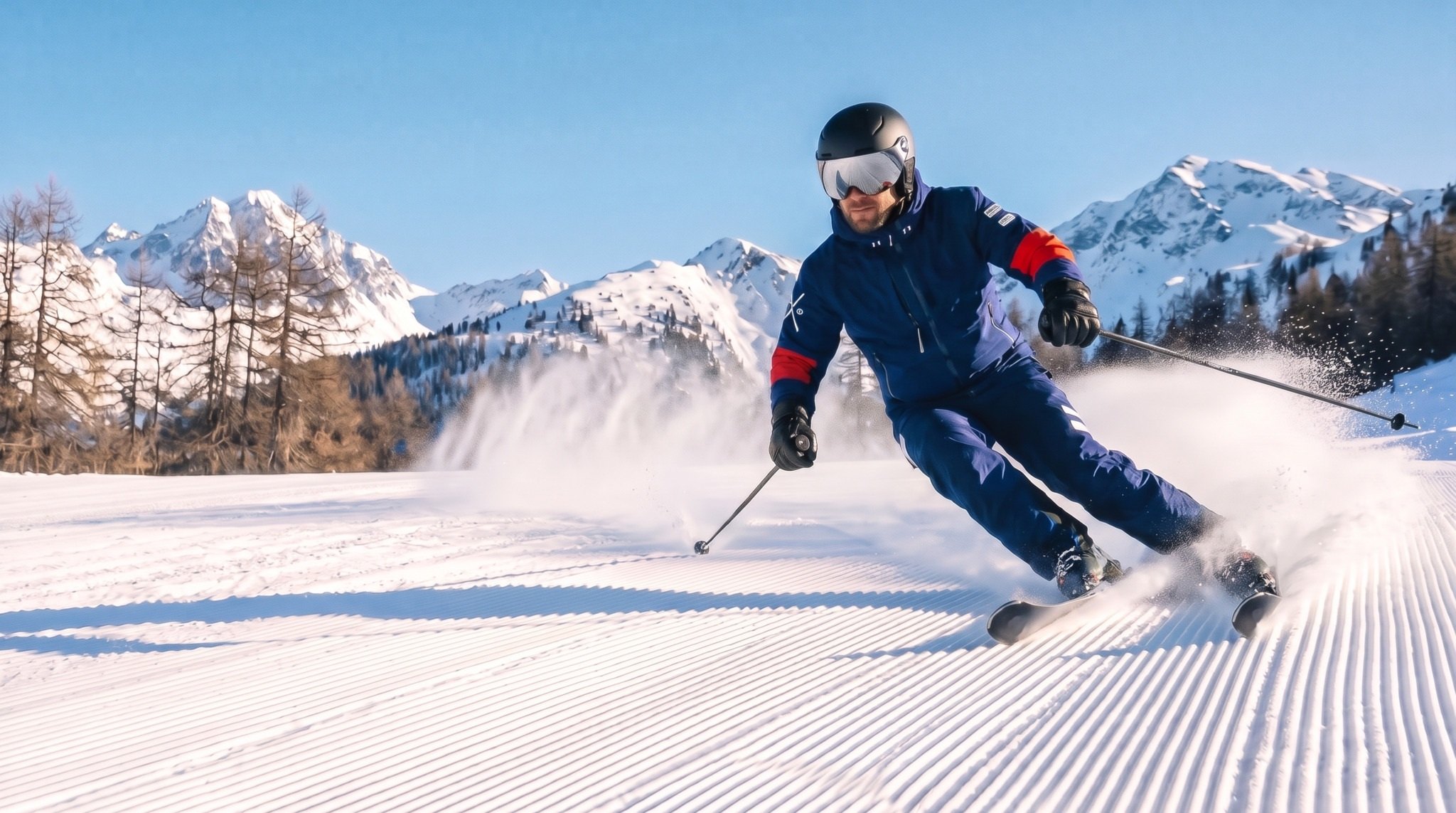
Skiing is braking work
On skis, gravity does the accelerating and your legs do the braking. Through much of a turn, your thigh muscles lengthen while they resist the pressure building under the ski. This is eccentric work. It sets skiing apart from running and cycling, where muscles mostly shorten to push.
In giant slalom turns measured on elite skiers, the quadriceps worked eccentrically for twice as long as they worked concentrically, and harder.1 Between braking phases, the same muscles hold a flexed stance without moving. That is isometric work, and it is the source of the familiar burn on a long run.
This is why fit runners and cyclists often suffer on their first ski days. In a study of fit recreational skiers, four hours of skiing reduced eccentric strength in the thighs for at least 24 hours. Its authors suggest that endurance training such as cycling or walking does not protect against this kind of fatigue.2
How much of a descent is pure braking is still debated. One energy analysis estimates that muscles have to absorb less than 40 to 50 percent of a descent's energy through eccentric work.3 Either way, braking strength is the quality daily life trains least, so it is where a ski programme starts.
The muscles that carry a turn
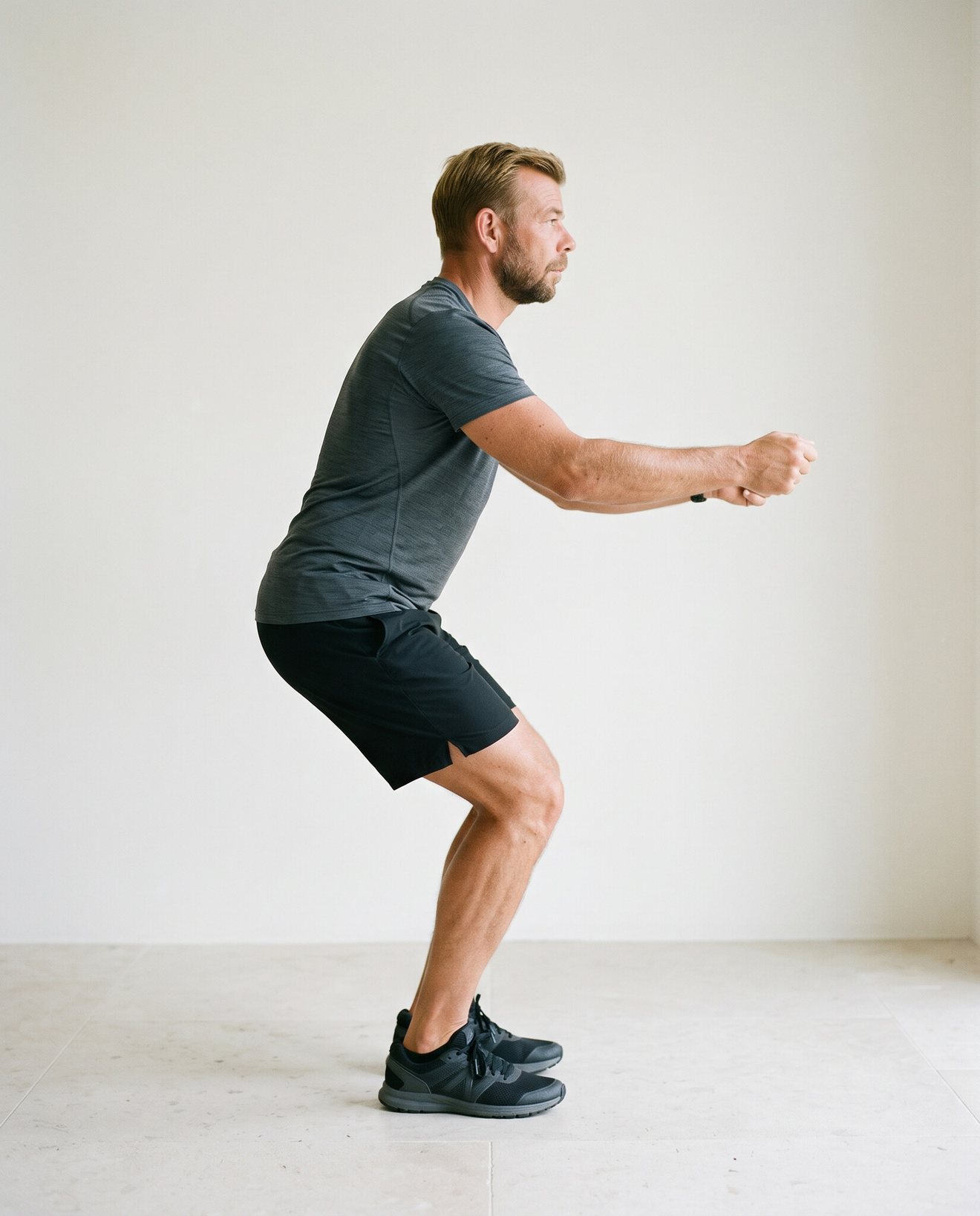
A ski stance seen from the side. Each number marks a muscle group your programme trains, and what it does on snow.
Quadriceps
Front of the thigh. They control how far and how fast your knees bend, absorb pressure through the turn and hold your stance.
Trained with slow-lowering squats, split squats and holds.
Glutes
The hip muscles. They extend the hip and, on the outside ski, keep your pelvis level and your knee from dropping inward.
Trained with single-leg work, lateral band work and hip extensions.
Hamstrings
Back of the thigh. They work with the quadriceps to stabilise the knee and help resist the shin being pulled forward under load.
Trained with hip hinges, bridges and slow hamstring curls.
Adductors and hip rotators
Inner thigh and deep hip. They steer your legs under a quiet pelvis and help hold both skis on edge.
Trained with lateral lunges and side-lying holds.
Calves and shin muscles
They manage pressure against the boot and make the small fore-and-aft corrections that keep you centred.
Trained with calf raises, ankle mobility and balance work.
Core
Abdominals, obliques and lower back. They keep your upper body calm while your legs turn beneath it, and pass forces between the two.
Trained with side planks, anti-rotation work and carries.
The demands, measured
What researchers have recorded on skiers, and what each result means for your preparation.
87%
of maximal heart rate during downhill skiing, as reported in a 2019 review. In the same comparison, cross-country skiing reached 88% and indoor cycling 82%.1
Runs are hard intervals, so intervals belong in your training.
24 h
at least. How long eccentric thigh strength stayed reduced after a four-hour ski session in fit recreational skiers.2
Build braking strength before the trip, and plan recovery between ski days.
−6.3%
maximal oxygen uptake for every 1,000 m of altitude gained, measured on endurance athletes between 300 m and 2,800 m.4
Between 300 m and lifts at 2,300 m, that is about 13 percent. An aerobic base pays off up high.
1 in 3
injuries in recreational skiers involves the knee. The ACL is the structure most often damaged in knee injuries that need hospital care.5
Strong thighs and hips, good balance and well-set bindings all matter.
4×
lower odds of injury, or more, for skiers with average or good balance scores than for those with poor scores, in a prospective study of 117 recreational skiers. Slow agility scores pointed the same way.6
Balance and agility are trained every week.
16 runs
of slalom in one day left some muscle fibres of elite junior skiers almost empty of glycogen, their stored carbohydrate.7
Eat and drink through the ski day, and train the endurance to last it.
Six qualities, trained in proportion
Your assessment sets the proportions. A strong cyclist usually needs braking strength first. Someone who lifts weights often needs balance and endurance.
Braking strength
Split squats, lowered slowly.
Balance
One leg, on an unstable surface.
Power
Jumps with controlled landings.
Core stability
Side plank with a reach.
Braking strength
Controlling pressure through every turn and absorbing bumps.
Squats and split squats lowered over three to four seconds, step-downs, holds of 30 to 90 seconds.
Strength endurance
Skiing the last run of the day as well as the first.
Efforts of 40 to 90 seconds with short rests, close to the length of a run.
Power and reactivity
Quick edge changes, short turns, recovering from a surprise.
Jumps with controlled landings, side-to-side bounds, fast changes of direction.
Balance and agility
Staying centred on one ski, on ice or in changing snow.
Single-leg exercises, unstable surfaces, footwork drills.
Core stability
A calm upper body over working legs.
Side planks, anti-rotation presses, loaded carries.
Aerobic base
Recovering on the lift, coping with altitude, lasting the week.
Brisk walking, cycling or swimming at a steady pace, plus intervals.
It starts with an assessment
On a video call, we go through your skiing, your training history and a few simple tests. None of them needs equipment.
I adapt or leave out any test that does not suit your history. Coaching is not medical advice, so tell me about any injury or medical condition before we start.
- Single-leg squat to a chair
- How each knee and hip controls the way down.
- Wall sit
- How long your thighs hold a ski stance.
- 60-second squat test
- How your legs cope with repeated efforts. A test used in research on recreational skiers.6
- Single-leg balance
- Eyes open, then closed, on each side.
- Side plank hold
- Trunk endurance, left and right.
- Knee-to-wall
- Ankle mobility for a forward stance in ski boots.
- Jump and landing
- How you absorb a landing and stay balanced.
An example week
Pre-season, for an intermediate skier training at home with a band, a step and a backpack. Your own week is written from your assessment.
- Monday, 50 minutes
Braking strength
Split squats lowered over four seconds. Step-downs. Hamstring bridges. Side plank.
- Wednesday, 40 minutes
Balance and intervals
Single-leg balance series. Lateral band walks. Six squat holds of 60 seconds, with 30 seconds of rest.
- Friday, 50 minutes
Power and endurance
Side-to-side bounds with controlled landings. Jump squats. Wall-sit ladder. Anti-rotation press.
- Weekend, 60 to 90 minutes
Aerobic base
A brisk hike, a bike ride or a swim, at a pace where you can still talk.
Five phases, one ski year
For skiers in the northern hemisphere. A Premium plan follows the whole cycle. Other plans start where your calendar allows.
- May to July
General preparation
Heavier, slower strength work. An aerobic base. Fixing the mobility limits found in your assessment.
- August to October
Specific preparation
Braking strength, longer holds and strength endurance. Power work and intervals come in.
- November to December
Pre-season
Reactivity, balance and agility. A lighter last week, so you arrive fresh.
- December to April
In season
Short sessions between ski days to keep your strength. Mobility and easy aerobic work for recovery.
- April to May
Recovery
Lower volume, other sports, and a review of the season to plan the next one.
What the research does not show
No study has yet proved that a fitness programme prevents ski injuries. A systematic review of injury prevention in recreational skiing and snowboarding found 80 recommendations in the literature, and none concerned physical training itself. Its authors called for that research to be done.8
So I make a modest claim. Preparation makes your ski days longer, steadier and more enjoyable, and it trains the balance and agility that one study links with fewer injuries.6 It does not replace well-adjusted bindings, good judgement on the slope, or a doctor's advice if you have a medical condition.
References
- Burtscher M, Federolf PA, Nachbauer W, Kopp M. Potential health benefits from downhill skiing. Frontiers in Physiology. 2019;9:1924. doi:10.3389/fphys.2018.01924
- Koller A, Fuchs B, Leichtfried V, Schobersberger W. Decrease in eccentric quadriceps and hamstring strength in recreational alpine skiers after prolonged skiing. BMJ Open Sport & Exercise Medicine. 2015;1:e000028. doi:10.1136/bmjsem-2015-000028
- Minetti AE. Concentric, isometric, and eccentric contractions: which dominates alpine skiing? In: Science and Skiing VII. Meyer & Meyer; 2018:23-29. Catalogue record
- Wehrlin JP, Hallén J. Linear decrease in VO2max and performance with increasing altitude in endurance athletes. European Journal of Applied Physiology. 2006;96:404-412. doi:10.1007/s00421-005-0081-9
- Posch M, Schranz A, Lener M, Tecklenburg K, Burtscher M, Ruedl G. In recreational alpine skiing, the ACL is predominantly injured in all knee injuries needing hospitalisation. Knee Surgery, Sports Traumatology, Arthroscopy. 2021;29(6):1790. doi:10.1007/s00167-020-06221-z
- Wang Z, Cai Y, Wu J, Xie S, Jiao W. Relationship between lower extremity fitness levels and injury risk among recreational alpine skiers: a prospective cohort study. International Journal of Environmental Research and Public Health. 2022;19(16):10430. doi:10.3390/ijerph191610430
- Vogt M, Jordan K, Spring H, Hoppeler H. Physiology of alpine skiing: implications for the training of elite skiers. International Congress Mountain & Sport, Rovereto; 2005. Abstract
- Hébert-Losier K, Holmberg HC. What are the exercise-based injury prevention recommendations for recreational alpine skiing and snowboarding? A systematic review. Sports Medicine. 2013;43(5):355-366. doi:10.1007/s40279-013-0032-2
See what your own programme would look like
Answer a short questionnaire. I reply personally and we set up your assessment.