Why your thighs burn on the first day
Almost every skier knows the feeling halfway down a long run. It comes from two kinds of work that daily life rarely asks of your quadriceps.
Holding the position
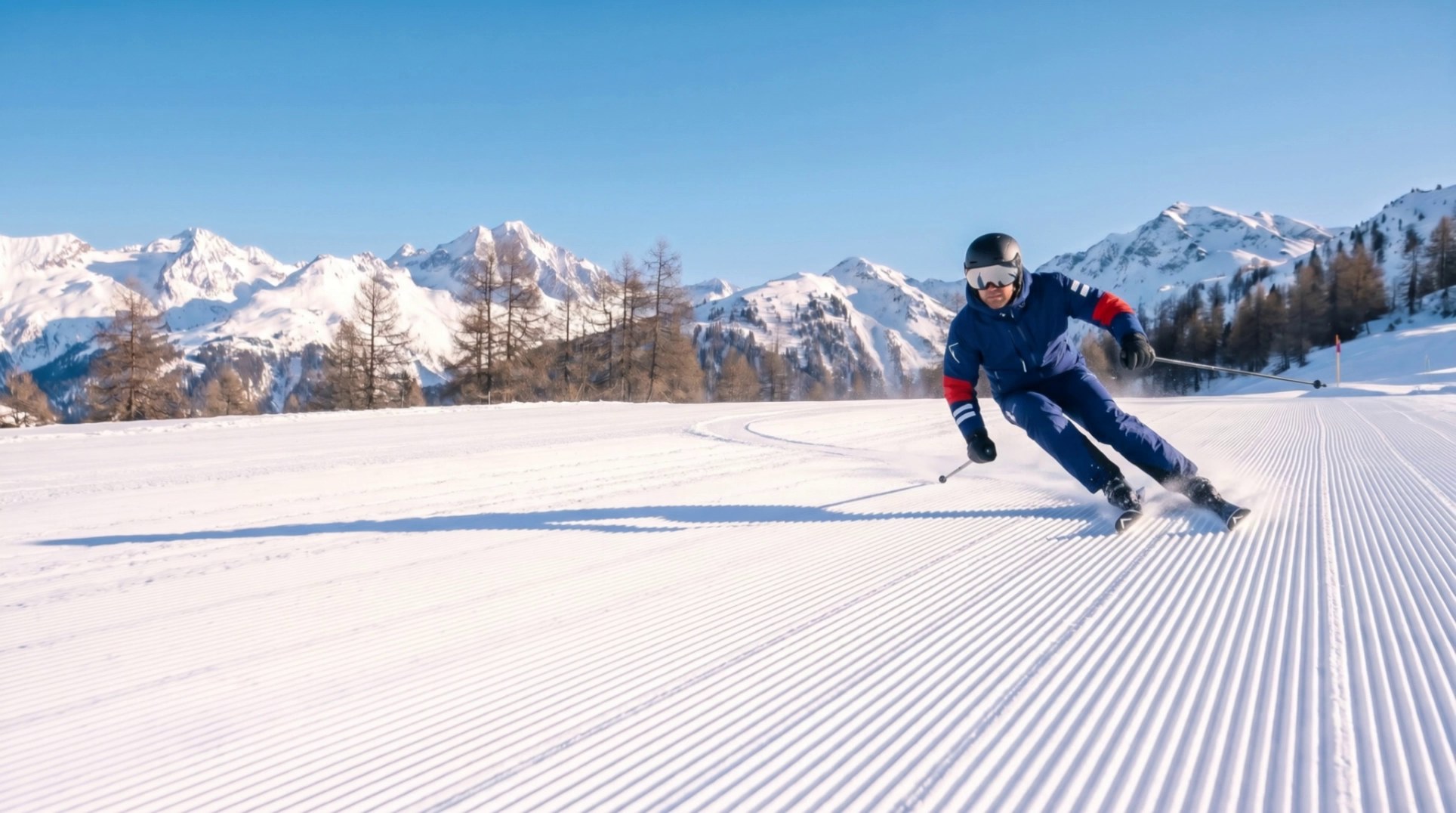
Skiing keeps your knees and hips flexed for long stretches. Your thigh muscles work without changing length to hold that stance, which is called isometric work. A sustained contraction squeezes the blood vessels inside the working muscle, so less oxygen gets in and the by-products of hard muscular work build up. The result is that familiar burning, and the urge to stop and stand up.
Braking and absorbing
The second kind of work is eccentric: the muscle lengthens while it resists, as when your legs absorb a bump or control the end of a turn. Eccentric work your muscles are not used to is the classic cause of the stiffness you feel on the second and third mornings of a trip. In elite skiers, this braking phase lasts about twice as long as the pushing phase in each giant slalom turn.1
Its effects last. In a study of fit recreational skiers, four hours of skiing reduced eccentric strength in the thighs for at least 24 hours.2
How to train for both
- Longer holds. Wall sits and split-squat holds, adding time week by week.
- Slow lowering. Squats and step-downs taking three to four seconds on the way down.
- Intervals. Efforts of 40 to 90 seconds with short rests, close to the length of a run.
- Single-leg work. Each leg learns to carry the load on its own, as it does on the outside ski.
Technique plays its part
Sitting back on your skis makes your quads carry far more of the load. Staying centred over your feet spreads the work across your hips and glutes. This is where ski fitness and ski technique meet, and why I look at both.
Burning legs on day one is normal. Burning legs every afternoon of the week is a sign that preparation can help.
References
- Burtscher M, Federolf PA, Nachbauer W, Kopp M. Potential health benefits from downhill skiing. Frontiers in Physiology. 2019;9:1924. doi:10.3389/fphys.2018.01924
- Koller A, Fuchs B, Leichtfried V, Schobersberger W. Decrease in eccentric quadriceps and hamstring strength in recreational alpine skiers after prolonged skiing. BMJ Open Sport & Exercise Medicine. 2015;1:e000028. doi:10.1136/bmjsem-2015-000028